Vercel Got Breached. You Probably Missed It (But You Shouldn't)
Vercel was breached through a supply chain attack via Context.ai. Here's what happened, what was compromised, and exactly what you should do right now.

In this article
- What the Heck is Vercel (Quick Context)
- What Actually Happened (The Supply Chain Plot Twist)
- The Damage Report (What Actually Got Leaked)
- Who’s Behind This? (The Villain Origin Story)
- The Latest Updates (As of April 20, 2026)
- What Vercel Says (Official Response)
- What Should You Actually Do (Right Now)
- Step 1: Did Vercel Contact You? (5 minutes)
- Step 2: Rotate Your Environment Variables (30-45 minutes)
- Step 3: Enable 2FA on Your Vercel Account (10 minutes)
- Step 4: Audit Recent Deployments (10 minutes)
- Step 5: Check Your Code (If You Stored Secrets in Code)
- Why This Matters (The Bigger Picture)
- For Crypto Projects Specifically
- Should You Panic? (The Honest Answer)
- What I’m Doing
- Quick Links
Disclaimer: This post reflects information available as of April 20, 2026. The situation is evolving, so check Vercel’s official security bulletin for the latest updates.
So imagine this: you’re casually scrolling Twitter on a weekend, and boom. Your entire feed is on fire. Vercel. Breach. API keys. GitHub tokens. The usual nightmare fuel.
If you’re seeing these posts for the first time, don’t panic. You’re not being targeted. But you probably should pay attention for the next 5 minutes. Here’s why.
What the Heck is Vercel (Quick Context)
Before I get into the scary stuff, let me give Vercel the credit it genuinely deserves.
Vercel is one of the best things that has happened to frontend developers. It’s a cloud platform that lets you deploy web applications (Next.js, React, Astro, Svelte, you name it) with essentially zero configuration. Push your code to GitHub, and it’s live. That’s it. No wrestling with servers, no Docker configs, no NGINX reverse proxies. Just git push and your app is on the internet.
And here’s the thing that makes Vercel special: their free tier is genuinely generous. You can host multiple projects, get automatic HTTPS, preview deployments for every PR, serverless functions, edge functions, and analytics. All for free. For indie developers, students, and hobbyist builders, this is a game-changer. You don’t need a credit card to ship something real.
I host my own projects there: this blog you’re reading right now, my DLS scoring system, and my portfolio. Vercel made it effortless for me to go from side project to production-ready app without thinking about infrastructure. If you’ve ever deployed something with vercel deploy, you know the feeling. It just works.
Vercel is also the company behind Next.js, the most popular React framework in the world. They’ve shaped how an entire generation of developers builds for the web. They’re not just a hosting company. They’re a cornerstone of the modern JavaScript ecosystem.
Which is exactly why a breach here hits different. When you trust a platform this much with your projects, your API keys, and your environment secrets, a security incident feels personal.
What Actually Happened (The Supply Chain Plot Twist)
Here’s the wild part: Vercel didn’t get breached because of a Vercel vulnerability.
They got breached because an employee used an AI tool called Context.ai.
A Context.ai employee’s computer was compromised with a malware called Lumma Stealer. The attacker then used those stolen credentials to compromise the Context.ai platform itself. When a Vercel employee later used Context.ai and granted it access to their Google Workspace account, the attacker used that connection to take over the employee’s Google account, which gave them access to Vercel’s internal systems.
Let me break this down because it’s actually important:
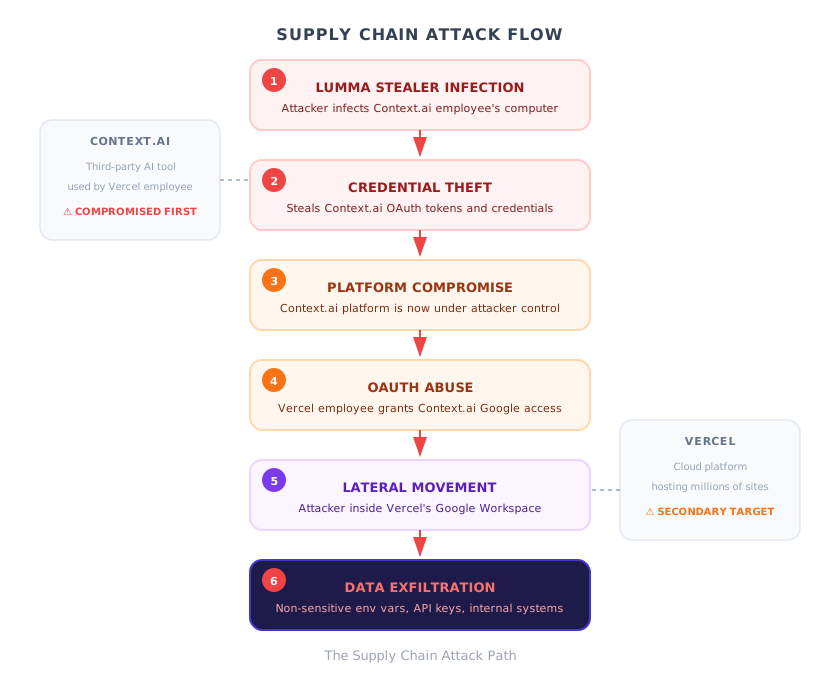
This is called a supply chain attack. It’s when hackers target someone’s trusted vendors instead of going after them directly. And honestly? It’s becoming the new normal.
The Damage Report (What Actually Got Leaked)
Here’s the good news and the “okay, maybe not so good” news.
The Good News: Sensitive environment variables in Vercel are encrypted at rest. If you marked your secrets as sensitive, they were NOT compromised. No evidence of access to those values was found.
The Not-So-Good News: A limited subset of customers had their non-sensitive environment variables (those stored as plaintext) compromised. This includes API keys, tokens, database credentials, and signing keys that weren’t marked as “sensitive.”
A threat actor posted on BreachForums claiming ShinyHunters affiliation, saying they had Vercel access keys, source code, NPM tokens, and GitHub tokens. They were asking $2 million for the data.
But here’s the thing, and this is important: ShinyHunters has publicly denied any involvement in this breach. The group stated they had nothing to do with the Vercel incident, suggesting someone was impersonating them to add credibility to the listing. So whoever is behind this is either a different actor entirely or someone deliberately trying to ride ShinyHunters’ reputation. The actual attacker’s identity remains unconfirmed as of this writing.
What wasn’t compromised: No npm packages published by Vercel were compromised. There is no evidence of tampering, and the supply chain remains safe. So Next.js is fine. Vercel’s open-source projects are fine. Your code is probably fine (unless you stored secrets in your code, but we don’t do that… right?).
Who’s Behind This? (The Villain Origin Story)
As of April 20, 2026, the attack chain has been traced back to an infostealer infection at Context.ai. The attacker compromised a Context.ai employee’s computer, stole their credentials, and used that access to laterally move into Vercel.
To be clear: this was NOT ShinyHunters. Despite a BreachForums post claiming ShinyHunters affiliation, the group has publicly denied involvement. The actual attacker remains unidentified.
Vercel CEO Guillermo Rauch described the attackers as “highly sophisticated” with “surprising velocity,” and likely “accelerated by AI.” Which is… ironic, given Context.ai is an AI tool.
In short: an unknown actor got into Context.ai first, used that to get into Vercel, and is now probably trying to sell the data while hiding behind someone else’s name. Classic 2026 cybercrime.
The Latest Updates (As of April 20, 2026)
Vercel has deployed extensive protection measures and monitoring. Services remain operational.
Here’s what they’re rolling out:
- An overview page of environment variables in the dashboard
- A better UI for sensitive environment variable creation and management
- Environment variable creation now defaults to “sensitive”
- Enhanced team-wide management of environment variables
Translation: Vercel is updating their product to make it harder for this to happen again.
What Vercel Says (Official Response)
Here’s the official guidance from Vercel:
If any of your environment variables contain secrets (API keys, tokens, database credentials, signing keys) that were not marked as sensitive, those values should be treated as potentially exposed and rotated as a priority.
And the remediation steps they recommend:
- Review the activity log for your account and environments for suspicious activity
- Review and rotate environment variables
- Take advantage of the sensitive environment variables feature going forward
- Investigate recent deployments for unexpected or suspicious looking deployments
- Ensure that Deployment Protection is set to Standard at a minimum
- Enable two-factor authentication (2FA)
In normal English: Rotate your secrets, turn on 2FA, mark secrets as sensitive, and watch for weird stuff in your audit logs.
What Should You Actually Do (Right Now)
Step 1: Did Vercel Contact You? (5 minutes)
Check your email. If Vercel reached out directly, you were in the affected “limited subset.” You need to rotate credentials immediately.
If you didn’t get an email, it doesn’t mean you’re safe. Vercel’s warning applies to everyone anyway.
Step 2: Rotate Your Environment Variables (30-45 minutes)
For every environment variable that contains a secret (API keys, database URLs, auth tokens):
- Go to your third-party service (Neon, MongoDB, Stripe, etc.)
- Generate a new credential (new database password, new API key, etc.)
- Go to Vercel dashboard → Project Settings → Environment Variables
- Edit the variable with the new value
- Ensure it’s marked as “sensitive” (new default as of today)
Do this for:
- Database credentials (Postgres, MongoDB, etc.)
- API keys (Stripe, OpenAI, Anthropic, etc.)
- OAuth tokens (GitHub, Google, etc.)
- Any authentication tokens
Step 3: Enable 2FA on Your Vercel Account (10 minutes)
Go to Vercel Account Settings → Security and enable two-factor authentication. Use an authenticator app (not SMS).
Step 4: Audit Recent Deployments (10 minutes)
In the Vercel dashboard, check:
- Deployments section: Look for unexpected deployments
- Activity logs: Look for unusual access (logins from weird IPs, etc.)
If something looks sus, delete that deployment.
Step 5: Check Your Code (If You Stored Secrets in Code)
This is the scary one. If you accidentally committed API keys to GitHub, they’re now potentially exposed.
Use a tool like GitGuardian or TruffleHog to scan your repo for leaked secrets.
If you find anything:
- Delete from GitHub history (force push, or use BFG)
- Rotate those credentials immediately
- Delete that old deployment from Vercel just in case
Why This Matters (The Bigger Picture)
This breach illustrates how trusted third-party apps and platform environment variables can bypass traditional defenses and amplify blast radius. The period from March to April 2026 has seen an unprecedented concentration of software supply chain attacks.
Translation: We’re in a “supply chain attack era” right now. It’s not just Vercel. It’s the whole ecosystem.
The lesson? You can’t just trust your own security anymore. You have to trust everyone else’s too. And when someone else messes up (like Context.ai getting hacked), it cascades.
For Crypto Projects Specifically
This incident is drawing particular scrutiny because many Web3 teams host critical wallet interfaces and dashboards on Vercel. They rely on environment variables to store credentials that connect their frontends to blockchain data providers.
If you’re running a crypto project on Vercel, this is extra critical. Rotate everything. Now.
Should You Panic? (The Honest Answer)
No. But also, yes. Let me explain.
You should NOT panic because:
- Vercel’s services are still up and operational
- They’re fixing it proactively
- If you used “sensitive” variables, you’re safe
- This is fixable in 30-45 minutes
You SHOULD take it seriously because:
- Non-sensitive environment variables were compromised
- If you store API keys in environment variables (which you should), rotate them
- Supply chain attacks are becoming the norm, not the exception
- Waiting gives the attacker more time to use your credentials
TL;DR: Spend the next 30 minutes rotating credentials, then move on with your day. This isn’t a “rebuild everything” situation. It’s a “take 30 minutes to be safer” situation.
What I’m Doing
I’m rotating my credentials. I’m marking everything as “sensitive” going forward. I’m enabling 2FA everywhere. And I’m building an automated credential rotation system so I don’t have to think about this every time someone gets hacked.
In my next blog post, I’m going to share that system. Stay tuned.
For now: go rotate your credentials, enable 2FA, and relax. You’ve got this.
Quick Links
- Vercel’s Official Security Bulletin
- GitGuardian Secret Scanner (scan your code for leaked secrets)
TL;DR: Vercel got breached via a third-party AI tool. Non-sensitive environment variables were exposed. Rotate your API keys, enable 2FA, mark secrets as sensitive, and move on. Takes 30 minutes. Worth it.
Stay secure. 🔐